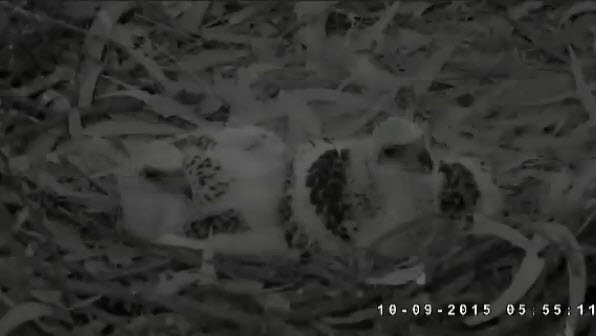
The Southwest Florida Eagles are on hatch watch this week. Today is day 33 for the first egg that was laid. That's the earliest that we might see a hatch. Although, with delayed incubation, I would expect the first laid egg to not hatch until around day 35 and the second laid egg to hatch on day 33 or 34. So, even though we are technically in the window for hatch, I would be surprised if we saw a hatch before Monday... Before hatching, the parent can often hear peeps from the egg. The parent seems to be listening here:
Two of the Upper Mississippi River trio arrived at the nest at 5:13 this evening. I then lost the signal (this happens when there are a lot of viewers because of bandwidth issues.) The third arrived at 5:14 - 5:15. So it seems that they all hang out together during the day. They didn't stay at the nest for long, since it was getting dark.
The Berry College Eagles are still incubating two eggs. I just found this picture from a couple of months ago, of Mom Berry bringing a huge piece of lumber to the nest. Keep in mind that her wingspan is 6 - 7 feet wide and that gives you an idea of the size of this limb. She didn't make it to the nest with the limb. It dropped near the photographer who took the picture. The limb weighs 12 pounds! Notice that she is carrying it with one foot. The other leg is the one that was injured and caused her to limp for the past two years. She's not limping any more, but you can tell by the way she stands that it didn't heal perfectly... Here's a s'cap from today, almost half-way through the incubation period:
Then Northeast Florida Eaglets are about a month old now and are standing already:
The Big Sur Condors are provided stillborn calves to feed on. This is a safe, lead-free, source of food. Preventing lead poisoning is helping to grow the population.
It may seem gross or uncaring to feed these calves to the Condors. But it is what nature intended. I know I feel differently when Bald Eagles bring prey items that have fur vs. something with scales to the nest. I just have to remind myself that predators help to control populations and scavengers have an important job to do too. We'd be hip-deep in carcasses without them!
The Condors are part of a flock.
I don't know if the spread wings is a display of dominance or if it's drying off or cooling off.
The chick is still in the nest. I like the date/time stamp at the top now. But today I noticed that I can't see the entrance to the nest. Bummer... I've seen a lot of feedings happen there, with the parent outside and the chick inside.
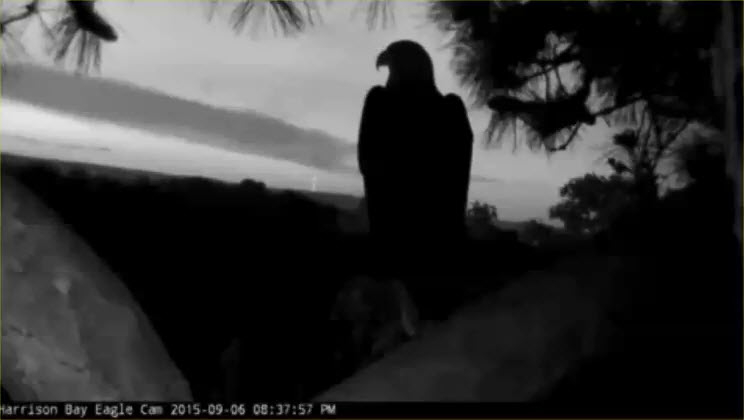
I think this is only one of the Harrison Bay Eagle parents perched in the tree. Look for the white head, right in the center of the s'cap...
The White-bellied Sea Eagle's SE15 on the left is so tiny compared to SE16.
I love this!
The female on the right has a more brownish chest than the male.
Here's an update of the migration of the Loch of the Lowes Osprey FR3 and FR4. I think this is fascinating! I hope their transmitters continue to function for a long time.
The Harrison Bay Eagles are starting to work on the nest bowl, laying in the center of the nest.
There's still a lot of grass growing in the nest...
The grass will get buried under clumps of soft grass that they will bring to the nest.
They shape the nest bowl and prepare it for eggs by laying in the nest while doing nestorations.
Here's an animated gif of a grand entrance this evening. Look at about 8 o'clock and you can see a white streak (way back) moving left to right. Then, LOOK OUT!
The White-bellied Sea Eagle chicks get up at dawn.
They patiently wait for breakfast.
The chicks are at the scary stage where they still aren't too steady on their feet. But they already like to go to the edge of the nest...
...then despite not being too steady, they start wingercizing like crazy.
This seems to be the standard position for feeding.
Here's an animated gif of a special moment at the White-bellied Sea Eagle nest. Bulls-eye!
Finally! Some new pictures of the Africam Black Eagle Fledgling Kendi! Click the link, and after the page fully loads, you can click on the main picture to make it bigger, then you can hover over the picture and see arrows at the edges to see all of the pictures. Kendi looks fantastic! I love the one where she's flying toward 7 o'clock. With her wings and tail spread out. So pretty. They've also updated their blog. There's also some pictures there!
Bald Eagle Ozzie hasn't been seen again with Harriet (the female resident) at the Southwest Florida nest. But FV/PB/M15 has been seen with her. Here's the deal with the name of the new fella. The male that moved into the territory in Ozzie's absence was first called Frequent Visitor (FV). He was also called Pretty Boy (PB). But now they have settled on Male 2015 (M15) which is more in line with how a lot of nests are naming their offspring.
No fledge today at the Africam Black Eagle nest. I had other s'caps from today, but can't find them. If I can find them, I'll post them tomorrow. The chick is perching up on the rocks in the s'caps I can't find... I guess that's the equivalent to branching.
I have no idea what to expect for a progressing with the Big Sur Condor chick. There is a month long window when it might fledge. I guess we'll just watch and wait!
Dad came by for a feeding. Red67 on the wing is "Kingpin." He is the boss of this flock.
I think this chick is getting fed every day.
Here's a video of the Feeding With Dad (3:53):
The White-bellied Sea Eagle chicks were awake early.
They were looking around.
They eventually came beak-to-beak. There were a few nips, but nothing serious.
The IR cam turned off and the nest was suddenly in color.
The parents are always close by.
Look at how big SE16 is! These babies change every day.
It looks like we will see their backs for feedings...
Here's the whole family.
SE16 is a lot more steady when standing. It will be awhile before they stand upright. For now, they will appear bent over.
SE16 did a poop shoot without falling over.
Oh my! What big wings you have already! I'd say those wings are at least a foot long.
They are both feathering out nicely. It looks like SE16's feathers are starting to open up after coming through the shaft. SE15 still looks like pin feathers. I am still amazed by the differences in these two chicks.